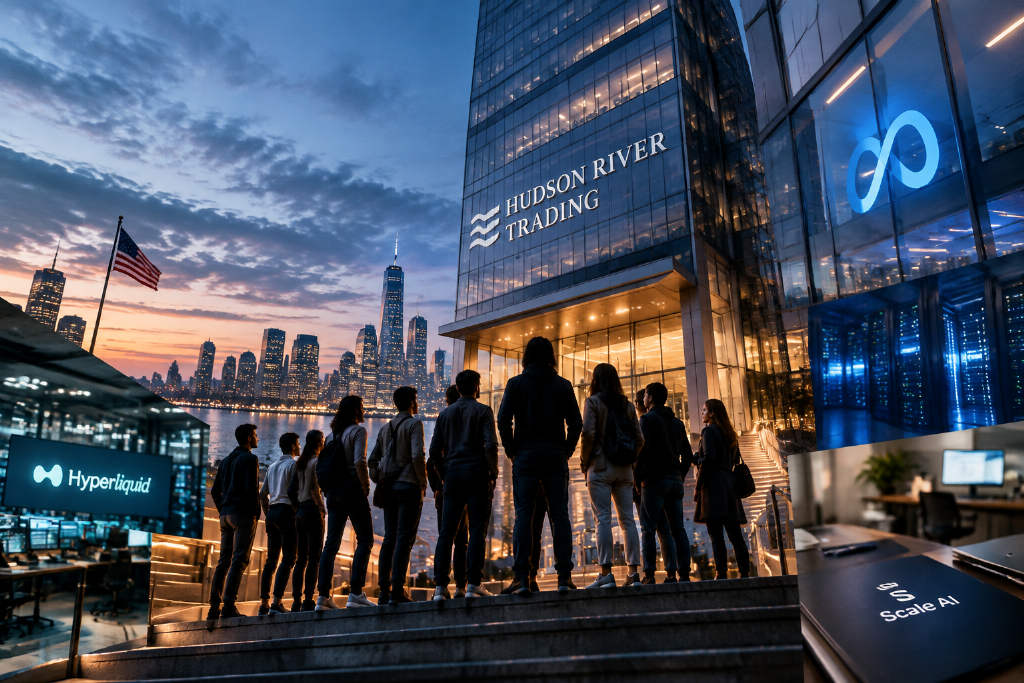
Hudson River 2026-10-19 10:11:15How HRT’s 2015 intern class grew into a $100 billion-plus founder networkA selfie posted by Meta Chief AI Officer Alexandr Wang has revived interest in one of the more unusual talent pipelines in tech: Hudson River Trading’s first intern class in the winter of 2015. The program took only 10 interns. A decade later, several of them have gone on to found or lead companies whose combined valuations now exceed $100 billion, according to the source article. The group includes Wang, the Scale AI founder who later joined Meta in a $14.3 billion deal tied to a 49% stake purchase; Jeff Yan, founder of decentralized exchange Hyperliquid; and Scott Wu, the Cognition CEO behind the AI coding agent Devin. The article traces how a small circle formed through Olympiad competitions and sharpened inside a quantitative trading firm later spread across AI infrastructure, crypto market structure, AI software engineering, customer service automation, search, and video generation. It also names other figures connected to the same orbit, including Jesse Zhang of Decagon, Johnny Ho of Perplexity, Demi Guo of Pika, and Steven Hao of Cognition. The core argument is not that they all built the same kind of company, but that they carried a similar way of thinking from math and programming contests into startups: identify an inefficient system, then rebuild it with algorithms and engineering.120
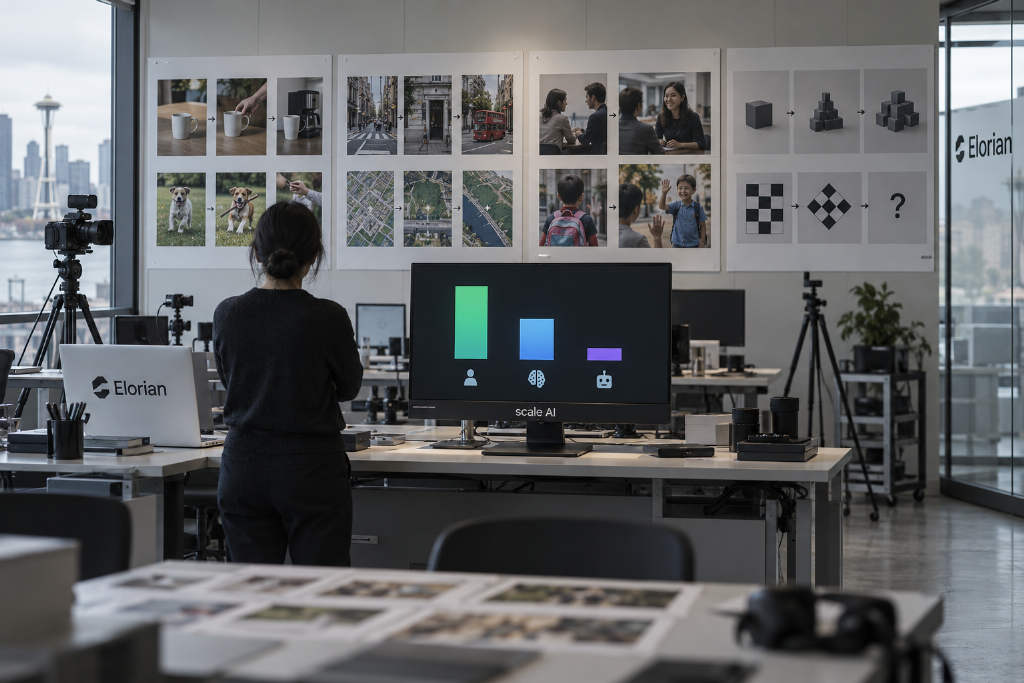
Scale AI2026-10-12 12:38:28Scale AI and Elorian launch visual reasoning benchmark, with GPT-6 Astra scoring 53.6Scale AI and Elorian have introduced Humanity's Sixth Sense, a new multimodal benchmark designed to measure how well AI models reason about implied information in visual scenes. The benchmark includes 522 questions drawn from 288 images and 234 short videos, with tasks grouped into four categories: temporal causality, physical space, social understanding, and abstract reasoning. Results released with the benchmark show a wide gap between human and model performance. Humans posted a baseline score of 93.1, while GPT-6 Astra, the top-performing AI system in the test, scored 53.6. Performance among Chinese open-source models was lower, with GLM-5.3-flash scoring 26.8. The research also identified the most common failure patterns for AI systems: missing details that determine the correct answer, which accounted for 21% of failures, and incorrect identification of objects, people, or roles, which accounted for 20%. The item was cited by Import AI.250
Meta2026-10-12 03:03:53Alexandr Wang lays out how Meta built Muse and why he left Scale AIMeta Chief AI Officer Alexandr Wang has given one of his most detailed accounts yet of how Muse, the company’s personal AI agent, went from concept to launch in seven months. In an interview with Founders host David Senra, Wang said the internal conviction behind Muse took shape after hands-on experiments with OpenClaw, including Nat Friedman using it to track whether he was drinking water and Wang himself letting an agent analyze his emails, photos, and other personal data in what he described as an experience similar to compressing three years of therapy into one session. Those tests helped persuade Meta leaders that a long-running personal agent could become a major consumer product, not just another chatbot. Wang said Meta had already set a broader “Personal Superintelligence” vision when Meta Superintelligence Labs was established in 2025. By February 2026, both he and Friedman had written memos to the board arguing for the category. Meta then built an initial Muse prototype in roughly one to two weeks, but spent seven months refining it before release, using a spreadsheet with more than 100 capability and behavior checks. According to Wang, Muse was not launched until the specially trained Muse Spark 1.3 model cleared all key evaluations. He also explained why Meta did not put its full weight behind coding agents, how Zuckerberg approached him after Llama 4 disappointed internally, and why MSL now uses an unusually flat structure with more than 200 researchers reporting directly to him.1130
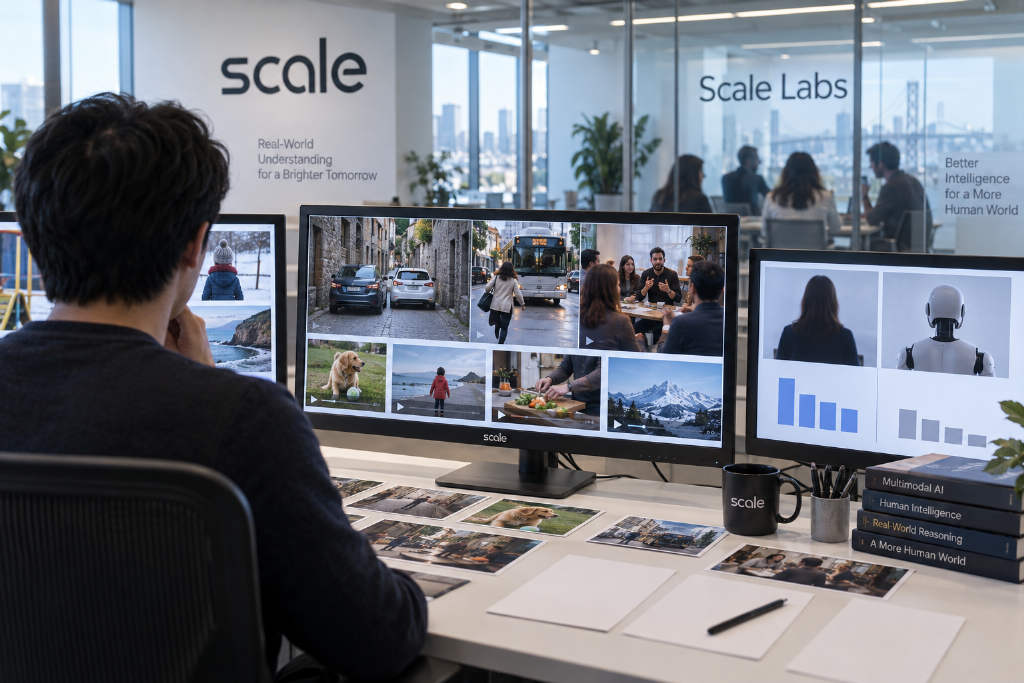
Scale Labs2026-10-08 11:32:17Scale Labs study finds 25 multimodal AI models still trail humans on everyday common-sense cuesScale Labs, a research unit under Scale AI, and Elorian have released a new benchmark called Humanity’s Sixth Sense, or HSS, aimed at testing whether AI systems can infer unstated information from images and videos. The benchmark includes 522 open-ended questions built from 288 images and 234 videos, covering situations such as whether two cars can fit through a gap, why a woman chasing a bus suddenly slows down, and who holds more social power in a scene. The team evaluated 25 multimodal models and compared them with 20 human participants. Humans posted a 93.1% accuracy rate, while the top-performing model, GPT-6 Astra, reached 53.6% even under its highest reasoning setting. GPT-6.1 Sol and Claude Opus 5.5 scored 46.6% and 44.6%, and the median score across all models was 30.9%. Researchers reviewed 8,573 model failures and said 94% were tied to missed visual cues, object misidentification, or an inability to infer implicit relationships in a scene. Only about 5% were labeled as logic errors. Social understanding was especially weak, and video questions were generally harder than image questions. The study also said more reasoning tokens did not consistently improve results.270
Meta2026-09-27 00:54:09Meta AI chief Alexandr Wang lays out the case for Muse as app gains tractionMeta Chief AI Officer Alexandr Wang has published an open letter explaining the thinking behind Muse, the AI assistant he has been leading at the company. In the letter, Wang frames Muse as a tool built to help ordinary people turn long-held ambitions into action, describing it as a “second brain” and an execution-focused manager that can help users plan, communicate, find funding and remove obstacles. The letter arrived as Muse posted strong early app metrics, adding to investor attention around Meta’s AI push and the value of its deal for Scale AI talent. According to Sensor Tower, Muse reached 2.8 million downloads across the U.S. and Canada App Store in its first 12 days, ahead of ChatGPT’s 1.3 million over the same period. The app also set a U.S. single-day record of 264,000 downloads on Sept. 19. Over the past five trading days, Meta’s market capitalization increased by about $234 billion. The report also revisits Meta’s 2025 acquisition of Scale AI staff, Wang’s move into the Chief AI Officer role, hardware unveiled at Meta Connect 2026, and the online discussion around Wang’s appearance and personal style at the event.1050
CAIS2026-07-13 09:46:09CAIS remote labor benchmark shows Fable 5 leading GPT-5.5 in paid task automationThe latest Remote Labor Index from the Center for AI Safety, developed with Scale AI, puts Fable 5 at a 16.1% automation rate on real freelance jobs, ahead of Opus 4.8 at 8.3% and GPT-5.5 at 6.3%. The benchmark uses 240 real projects sourced from verified Upwork freelancers across 23 fields and asks a simple question: would a paying client accept the result? CAIS said the frontier has advanced more than fourfold in less than eight months, up from a top score of 2.5% when the index launched. The group also said AI judging is still unreliable. Automated evaluation overstated GPT-5.5 by nearly 3x and Opus 4.8 by about 2.5x when applied to newer systems. Fable 5’s run was interrupted by U.S. government export controls and covered 218 of 240 projects, but CAIS said even if all 22 missing tasks were counted as failures, its automation rate would still be 14.6%, higher than every other model tested.1860
Meta2026-07-10 12:00:00SemiAnalysis says Meta could overtake Google in six months in the race for AI’s third spotSemiAnalysis argues that Meta could move past Google within the next six months and become the strongest challenger behind OpenAI and Anthropic, though it says that outcome is still far from certain. The report rests on three main pillars: Meta’s $14.3 billion investment in Scale AI and the addition of founder Alexandr Wang, a reported shift of about 3,000 engineers toward building reinforcement learning tasks, and multi-gigawatt computing expansion tied to the company’s superintelligence push. The report does not claim Meta is already at the frontier. Meta released Muse Spark in April, and Axios reported on July 9 that Muse Spark 1.1 had opened its API to developers at $1.25 per million input tokens and $4.25 per million output tokens. Axios also said the model was not the leap Meta had hoped for, while a larger model codenamed Watermelon remains in training. SemiAnalysis frames the debate around speed of improvement rather than current rankings. It says Meta has redirected money, talent, engineering capacity and data center resources into its superintelligence lab after Llama 4 stumbled. Even so, the key question remains the same: whether Meta’s next-generation models can translate hiring, RL data pipelines and infrastructure buildout into products that actually narrow the gap with the leading labs.540
Meta2026-07-04 02:39:07Meta Shifts to Proprietary AI as Watermelon Reportedly Gets 10x the Compute of AvocadoMeta is reportedly escalating its AI strategy by allocating ten times more compute to its next proprietary model, Watermelon, than it did to Avocado. According to comments attributed to Meta AI chief Alexandr Wang, the move signals a broader shift away from the open-source Llama line toward closed, in-house systems designed to narrow the gap with OpenAI. The report also notes that Avocado was delayed to May 2026 after trailing Google Gemini 3.0 in November last year, while Watermelon is said to have reached the level of GPT-5.5. Combined with Meta’s $14.3 billion investment in Scale AI and Wang’s appointment as Chief AI Officer, the development is drawing attention from crypto market participants watching AI-linked infrastructure plays. In particular, the news may affect sentiment around decentralized compute platforms such as Render and Akash, although no direct on-chain, revenue, or partnership data was cited in the source report.1360